
Where Missouri Probation and Parole Kansas City Releases Go
The Kansas City region is served by MODOC field offices and residential or transition programs. These locations are community-corrections channels, not Jackson County jail branches. A person can leave prison on parole or conditional release and remain under MODOC legal authority. Probation may begin as a court sentence in the community, often instead of an executed prison term.
A move from an institution to a field office, from a residential center to community placement, or between districts is a status and assignment change. Final discharge occurs only when the sentence or supervision ends under the governing record. The correct evidence is the MODOC status, assigned office, and completion or discharge document, not the fact that a person has a community address.
Community is not discharge: Active parolees and probationers can remain in the MODOC public search after leaving confinement.
How to Confirm Kansas City Probation or Parole Status
Search the MODOC Offender Search, which covers active offenders and expressly includes probationers and parolees. Record the gateway's freshness timestamp, complete the CAPTCHA, and match the person by DOC ID and case information rather than name alone.
- Search the legal first and last name and repeat a known alias when necessary.
- Match the DOC ID, birth date, cause number, sentence county, or other displayed identifier.
- Preserve the exact field-supervision, institution, or assigned-place wording.
- Use the facilities and offices directory to identify the office attached to the active record.
- Call that office to confirm whether the assignment is current and which public record proves status.
- If no active result appears, use MODOC historical Sunshine data and request a discharge record.
Do not assign someone to District 4 or District 4W based only on a neighborhood or ZIP code. MODOC's live assignment controls. Staff may restrict details, but the public offender record and Sunshine process still provide official routes.
Kansas City MODOC District Office Contacts
The MODOC office address listing identifies two verified Kansas City entries. District 4 is at 615 E. 13th Street, Suite G-7, Kansas City, Missouri 64106, with 816-482-5750. District 4W is at 1330 Brush Creek, Kansas City, Missouri 64110, with 816-251-0759. These addresses are contact points, not proof of any individual's assignment.
Kansas City Field Offices
District 4
615 E. 13th Street, Suite G-7
Kansas City, MO 64106
816-482-5750
District 4W
1330 Brush Creek
Kansas City, MO 64110
816-251-0759
Division central contact is at 230 Metro Drive, Jefferson City, Missouri 65109, with 573-526-3231 and Probation.Parole@doc.mo.gov. Use central contact for directory routing, then use the assigned district for an individual active case.
Missouri Probation and Parole's Published Role
The official Division page describes Missouri community supervision and institutional release planning. The manifest includes a successful image expressly tied to this statewide role and directory path. The MODOC Division page explains the supervision function and provides navigation.
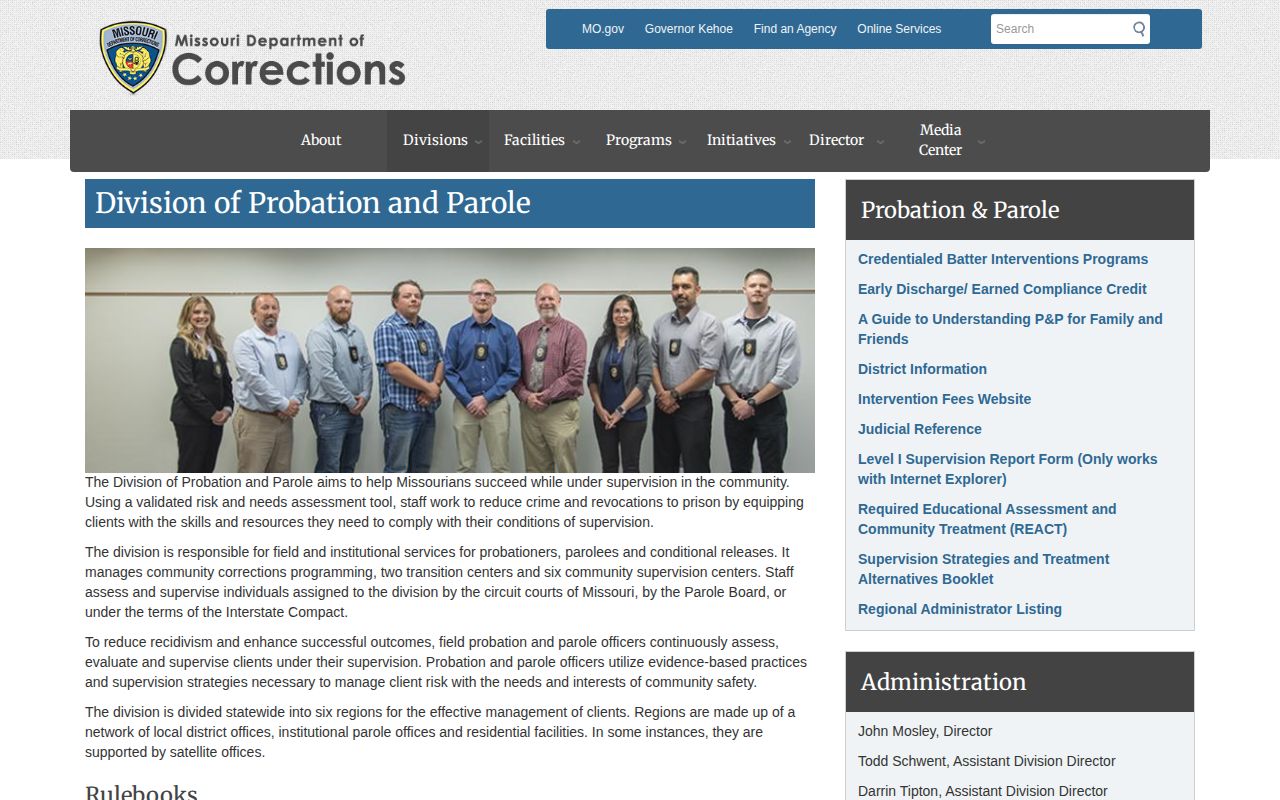
Institutional release planning and field supervision connect, but they are not the same record. A Parole Board decision concerns release authority. An institution processes the prison exit. A field office supervises an active community case. A discharge document shows when Department authority ends.
Kansas City Supervision Status Terms
Parole follows imprisonment and is discretionary. Conditional release can move an eligible person from prison into a statutory supervision term. Probation is imposed by a court and may occur without an executed prison term. All three can create active MODOC community records. Discharge ends the relevant sentence or supervision.
| Status | Custody or supervision meaning | Best verification |
|---|---|---|
| Parole | Community status under continuing MODOC legal custody | Active search and assigned field office |
| Conditional release | Prison-to-community phase under Department supervision | MODOC record, decision, and field office |
| Probation | Court-ordered community supervision | Court case, active search, and field office |
| Final discharge | Sentence or supervision ended | Discharge certificate or completed sentence record |
Do not use the terms interchangeably. The exact label determines whether a person remains subject to supervision, conditions, warrants, or retaking even after an earlier jail or prison release.
Proving Missouri Supervision Completion
Section 217.703 provides eligible people 30 days of earned compliance credit for each full compliant calendar month. Credit does not accrue during custody, an absconder period, or certain violation or revocation proceedings, and it can be rescinded. The provision can shorten qualifying supervision, but it does not set the original prison gate date.
The durable proof of completion is an order or certificate of discharge, or a MODOC sentence record showing completion. MODOC's active web search excludes discharged offenders. A no-match is therefore consistent with completion, but it is not conclusive because spelling, confidentiality, and other public-display limits can also cause silence.
MODOC Sunshine data includes a Completed Flag and other sentence fields. Reconcile every row tied to the DOC ID and cause numbers. Then request the underlying discharge record through OD.SunshineRequest@doc.mo.gov when exact proof is needed.
Earned compliance credit concerns qualifying supervision time; it should not be turned into a promised discharge calculator.
Absconders and Kansas City Supervision Warrants
The Division describes a round-the-clock Command Center that supports community monitoring and residential-center programs, investigates serious violations, issues warrants when clients fail to return, and coordinates with law enforcement. No official public statewide Missouri parole-absconder list was located.
Section 217.703 defines an absconder for earned-compliance purposes as a supervised person whose location is unknown and who left a residence without officer permission or notice to avoid supervision. Section 217.720 addresses warrants and retaking. An absconder designation does not erase the earlier prison release. It means supervision remains active and a return to custody may follow.
Verify a warrant with the assigned field office or law enforcement rather than relying on rumor or a missing public search result. A residential-center departure can also be a violation or placement event, not final discharge.
Residential Centers Are Structured Missouri Placements
Residential facilities in the Kansas City region can serve people under MODOC supervision. A move into one is not equivalent to booking at the county jail, and a move out is not necessarily unconditional release. The Transition Center of Kansas City, for example, uses a four-phase corrections program with community partners.
Ask which office or program held authority on the relevant date, what movement occurred, and whether field supervision continued afterward. The Transition Center status guide explains how to distinguish its program steps from final MODOC discharge.
Parole Board Decisions Versus Kansas City Field Records
The Missouri Parole Board decides parole matters, while a Kansas City field office supervises an active community case. A Board grant can set a future date, but it does not document the institutional gate event or later field-office assignment. A hearing can also result in denial, reconsideration, extension, rescission, or a revocation-related decision.
For a clean timeline, obtain the Board decision when parole authority is at issue, the institution movement for physical release, and the District 4 or District 4W record for community supervision. Ask which office currently owns the case rather than relying on an old address. When discharge later occurs, request the completion or discharge record from MODOC.
The Missouri Parole Board uses 573-751-8488 and DOC.MissouriParoleBoard@doc.mo.gov. Its Sunshine address is ParoleBoard.SunshineRequest@doc.mo.gov. These contacts address Board process and records; they do not replace the assigned officer for current supervision questions.
MOVANS is the Department's documented notification layer for eligible recipients. It can provide specified information about parole hearings, location, scheduled release, and custody changes. Phone notices repeat until the personally selected PIN is entered. That service is distinct from the public active search and is not a universal public supervision roster.
A notification should be verified against the office record when the current assignment matters. A location change can point to another district, residential program, or institution. A scheduled date can change before the event. Preserve the notice, then ask the assigned office for the exact public status and the record that will later establish discharge.
About Missouri Probation and Parole Kansas City Records
These Kansas City offices administer state community supervision. They do not operate the county jail, decide every parole grant, or maintain a public list of everyone ever discharged. Their role is most useful after the active MODOC search identifies a field assignment.
A reliable supervision timeline combines the court or Parole Board authority, institution release, active field record, residential movements, earned-credit history when applicable, and final discharge. Keeping those sources distinct avoids a central error: describing a person who remains under MODOC authority as fully discharged merely because the person lives in the community.
Public Record Search
Sponsored Results